
Monday, August 22, 2011

Tuesday, August 16, 2011
Welcome to the 2011-2012 School Year
Hello and welcome to the start of the school year. Please check back frequently after the first day of school for information and happenings in our classroom!
Monday, January 10, 2011
Growing with Christina
In keeping with our survival theme, Skyler's Mom, Christina came in last week to help us with planting. Yes, planting in January! We have planted lettuce, sunflower, chives, tomatoes, potatoes and a few other seeds. When we first began, Christina asked the question, "What do plants have to do with survival?" the responses were: to give us oxygen, to give us food, to help us breathe, to provide shelter. We plan to expand on these ideas over the next few weeks as we delve into the theme of survival. We will also revisit these themes again in the spring when we attend Ohio State's Scarlet and Gray Ag(riculture) Day in May.


Thursday, December 2, 2010
The Danger Box by Blue Balliet
Our new read aloud is titled The Danger Box. This is author Blue Balliet's fourth book. Her first three, Chasing Vermeer, The Wright Three and The Calder Game center around a mystery and an artist. Three friends try to solve the fictional mystery that she creates around the actual piece of art. She departs from the three friends and the art in this novel, instead choosing a scientist (Charles Darwin) and two friends. It's a complicated and intriguing book, with many twists and turns, but a satisfying read in the end. She crates memorable characters and weaves a complex plot of mystery.
For more info, please read the review below from School Library Journal:
"Balliett's latest mystery explores the intricacies of scientific discovery. Wealthy Mr. Zip has arranged for a priceless treasure, stolen years ago, to be delivered to him. He will indulge his dream of savoring this object, and then will return it to society, a magnanimous gesture that will ensure that he is remembered as a hero. Sadly, before the treasure reaches him, Mr. Zip dies of a heart attack. When a mysterious man in possession of the box learns about this, he senses opportunity for personal gain, but before he can learn what he's transporting, his truck is stolen. Switch to our narrator, Zoomy, an engaging 12-year-old who, with pathological myopia, sees the world differently than those around him. Raised by his grandparents, he is pulled into the intrigue when his absent and alcoholic father makes a brief reappearance in his life with the box. Inside, Zoomy and his grandparents find only an old notebook wrapped in a blanket. An inveterate list-maker and notebook-keeper himself, Zoomy immediately falls in love with the journal, sensing a kindred spirit in the creator. He attempts to learn more about its history as the man schemes to reclaim that which does not belong to him, and as issues of The Gas Gazette provide clues but no answers about a "mysterious soul." Balliett demonstrates how danger boxes are all around us–not just as containers of physical objects for which people will hazard a great deal, but as vehicles that expose us to risky ideas and dreams. This highly satisfying story will enlighten readers even as it inspires them to think about their own danger boxes."
Wednesday, December 1, 2010
Survival
We are currently in the beginnings of our survival study. After completing the Marshmallow Challenge, we have begun to brainstorm what survival means and read stories of survival. Each person read a nonfiction picture book and wrote how the story was one of survival. Next, with a partner, students made a Venn diagram to look at similarities and differences contained in their stories. We are recording these and they will be posted in Moodle as podcasts in the near future. We are practicing podcasts as a result of an idea many students brought up in class -- to create a Wickliffe newspaper. After investigating we found two other classroom are possibly investigating writing newspapers, so we decided to create a "Wickliffe Weekly News" podcast. Look for more information in the near future.
In addition to comparing survival stories, we are also looking at survival events throughout history, how people survive, animal survival and qualities of survival. Eventually, each person will choose one event to study in depth about survival. We will be previewing these topics next week. Also next week, students will work in small groups to build bridges, perhaps a necessity to survival? We'll see! Stay tuned...
Poetry Workshop
The "Try It Out" for this week's poetry workshop was writing "How To Be" Poems. We shared a few and then tried out a group poem: "How To Be the First Snowflake" (appropriate for the day, we thought). This inspired many interesting, thoughtful and creative poems. Please see just a sample below.
How To Be Anything
Be
Live
Think
Hope
Dream
Thing Big
Reach for the Sky
Love What You Do
And make sure to
Believe
How To Be the First Snowflake
Descend on the first of December
Be in the clouds ready to drop
Get an early start and fall
Dive down and feel like a plane
Gliding through the air,
Crystal clear
How To Be a Light Bulb
Soak up electricity
Be bright
Be smart
Sometimes burn out
Symbolize ideas
Turn on and off
Flicker and spark and
Shine your soul
How To Be a Light Bulb
Soak up electricity
Get hotter and hotter
Start glowing
Reply to the call of the switch
Give lots of light
Symbolize ideas
Freak people out by flickering
Repel the monsters under the bed
End your life with a final flicker
How To Be a Doodler
Imagine your creatures
Use your surroundings
Give it your best try
Use your best skill to create it
Have fun with it
Take your time
Keep doing it
Draw what you can
Take it from someone who knows
Don’t care what other people think
It’s the best by how much love you put into it.
How To Be Anything
Be
Live
Think
Hope
Dream
Thing Big
Reach for the Sky
Love What You Do
And make sure to
Believe
How To Be the First Snowflake
Descend on the first of December
Be in the clouds ready to drop
Get an early start and fall
Dive down and feel like a plane
Gliding through the air,
Crystal clear
How To Be a Light Bulb
Soak up electricity
Be bright
Be smart
Sometimes burn out
Symbolize ideas
Turn on and off
Flicker and spark and
Shine your soul
How To Be a Light Bulb
Soak up electricity
Get hotter and hotter
Start glowing
Reply to the call of the switch
Give lots of light
Symbolize ideas
Freak people out by flickering
Repel the monsters under the bed
End your life with a final flicker
How To Be a Doodler
Imagine your creatures
Use your surroundings
Give it your best try
Use your best skill to create it
Have fun with it
Take your time
Keep doing it
Draw what you can
Take it from someone who knows
Don’t care what other people think
It’s the best by how much love you put into it.
Thursday, November 18, 2010
What Motivates Us?
What motivates you?
food/candy
learning something/gaining knowledge
friends and teachers
reading/books
someone telling you what to do
other people sharing
time
when you see someone else doing something cool
money
knowing you will get a good grade
knowing you will have a feeling of accomplishment
sports
seeing someone not as fortunate
We had an interesting discussion today about what is motivating to each of us. We asked the question, "what motivates you in school?" The list above is what we brainstormed. We also talked about extrinsic and intrinsic motivation - a very interesting and thoughtful discussion. If you get a chance, ask your child about our discussion.
food/candy
learning something/gaining knowledge
friends and teachers
reading/books
someone telling you what to do
other people sharing
time
when you see someone else doing something cool
money
knowing you will get a good grade
knowing you will have a feeling of accomplishment
sports
seeing someone not as fortunate
We had an interesting discussion today about what is motivating to each of us. We asked the question, "what motivates you in school?" The list above is what we brainstormed. We also talked about extrinsic and intrinsic motivation - a very interesting and thoughtful discussion. If you get a chance, ask your child about our discussion.
Wednesday, November 17, 2010
Reading Grafitti Part 2 Set 1
Our Reading Grafitti board became so full, we had to type up all the descriptive, meaningful lines (thanks, Miss Petrolo!) and display them around the board to make new space. Well, the Graffitti Board is almost filled again! We will add those savory bits of language to the collection soon, but in the meantime, please enjoy our first set of words. We have been sharing them in class. Beautiful and fun to read again and again!
“Which brings me to your last question. And that question is: How do you know if you are a writer? For once, I am going to answer a question as directly as I am able. My answer goes like this: You know you are a writer if you are imaginative. You know that you are a writer if you are curious. You know you are a writer if you are interested in the things and people of the world. You know you are a writer if you like the sound of rain on the roof. And if you want to tell someone else about your heart and how waiting for the thunder sometimes makes you feel, if you work to find the words to do that, then you are a writer.”
p. 118 Funny Business by John Sciezka and Kate DiCamillo
“A wise man once remarked that we can count how many seeds are in an apple, but not how many apples are in the seed.”
p. 157 Jeremy Fink and The Meaning of Life by Wendy Mass
“Home is family and family is home.”
Little House on the Prairie by Laura Ingalls Wilder
“Well did you know that dinosaurs really didn’t go extinct? Aliens were so fascinated by them that they decided to gather them all up and take them to their own planet.”
p. 129 I Am Number Four by Pittacus Lore
“Now what in the hokie smokies could that mean?”
p. 58 Emily’s Fortune by Phyllis Reynolds Naylor
“And three sets of soft snores rose to the shining ceiling.”
p. 13 Once Upon a Marigold by Jean Ferris
“The butler knocked on one of the black doors, and a voice boomed, ‘Bring her in.’ an involuntary shiver ran through Charlotte. The voice seemed to penetrate her body.”
p. 341 The Shadow Thieves by Anne Ursu
“Sometimes you never feel meaner then the moment you stop being mean. It’s like how turning on a light makes you realize how dark the room had gotten.”
p. 144 When You Reach Me by Rebecca Stead
“All the kids are in a costume. We have bought a leash for Bernie Kosar who is wearing a Superman cape draped over his back, a large ‘S’ on his chest. He seemed unimpressed with it. He’s not the only dog dressed as a superhero.”
p. 125 I Am Number Four by Pittacus Lore
“We are inside the universe, and the universe is inside us.”
p. 218 Jeremy Fink and the Meaning of Life by Wendy Mass
“Supper in the cloth sack and a lot on his mind.”
p. 75 Once Upon a Marigold by Jean Ferris
“Don’t give up hope just yet. It’s the last thing to go. When you have lost hope you have lost everything.”
p. 124 I Am Number Four by Pittacus Lore
“Imperious little son of the gun acting like some big cheese in a small pond.”
p. 15 Once Upon a Marigold by Jean Ferris
“Don’t sit under the apple tree with anyone else but me anyone else but me anyone else but me No! No! No! don’t sit under the apple tree with anyone else but me till I come marching home.”
p. 50 The Journal of Scott Pendleton Collins by Walter Dean Myers
“Good people I will sing you a little ditty and hope that it doesn’t annoy I make an appeal to your pity for I’m and unfortunate boy. Twas under an unlucky planet that I was born one night my life since first I began it has been cursed in dark and light o do not make sport of my troubles but pity one who feels no joy for I’m an uncomfortable horrible, terrible inconsolable Jonah boy.”
p. 23-25 Journal of James Pease by Jim Murphy
“A closed mind gathers no moss.”
p. 104 Once Upon a Marigold by Jean Ferris
“The towering trees swayed and whispered in the breeze.”
p. 92 Week in the Woods by Andrew Clements
“We all have disabilities. What’s yours?”
Out of My Mind by Sharon M. Draper
“His howdy doody cue seemed to dance in the air.”
p. 59 Crime Scene Whodunit’s by Jim Sukach
“I have never spoken one single word. I am almost eleven years old.”
p. 2 Out of My Mind by Sharon M. Draper
“Sleeping in there was like sleeping up in the night sky with the glitter of stardust all around you.”
p. 11 Once Upon a Marigold by Jean Ferris
“Scratching his head as if he might dig up an idea.”
p. 77 Crime Scene Whodunit’s by Jim Sukach
“Which brings me to your last question. And that question is: How do you know if you are a writer? For once, I am going to answer a question as directly as I am able. My answer goes like this: You know you are a writer if you are imaginative. You know that you are a writer if you are curious. You know you are a writer if you are interested in the things and people of the world. You know you are a writer if you like the sound of rain on the roof. And if you want to tell someone else about your heart and how waiting for the thunder sometimes makes you feel, if you work to find the words to do that, then you are a writer.”
p. 118 Funny Business by John Sciezka and Kate DiCamillo
“A wise man once remarked that we can count how many seeds are in an apple, but not how many apples are in the seed.”
p. 157 Jeremy Fink and The Meaning of Life by Wendy Mass
“Home is family and family is home.”
Little House on the Prairie by Laura Ingalls Wilder
“Well did you know that dinosaurs really didn’t go extinct? Aliens were so fascinated by them that they decided to gather them all up and take them to their own planet.”
p. 129 I Am Number Four by Pittacus Lore
“Now what in the hokie smokies could that mean?”
p. 58 Emily’s Fortune by Phyllis Reynolds Naylor
“And three sets of soft snores rose to the shining ceiling.”
p. 13 Once Upon a Marigold by Jean Ferris
“The butler knocked on one of the black doors, and a voice boomed, ‘Bring her in.’ an involuntary shiver ran through Charlotte. The voice seemed to penetrate her body.”
p. 341 The Shadow Thieves by Anne Ursu
“Sometimes you never feel meaner then the moment you stop being mean. It’s like how turning on a light makes you realize how dark the room had gotten.”
p. 144 When You Reach Me by Rebecca Stead
“All the kids are in a costume. We have bought a leash for Bernie Kosar who is wearing a Superman cape draped over his back, a large ‘S’ on his chest. He seemed unimpressed with it. He’s not the only dog dressed as a superhero.”
p. 125 I Am Number Four by Pittacus Lore
“We are inside the universe, and the universe is inside us.”
p. 218 Jeremy Fink and the Meaning of Life by Wendy Mass
“Supper in the cloth sack and a lot on his mind.”
p. 75 Once Upon a Marigold by Jean Ferris
“Don’t give up hope just yet. It’s the last thing to go. When you have lost hope you have lost everything.”
p. 124 I Am Number Four by Pittacus Lore
“Imperious little son of the gun acting like some big cheese in a small pond.”
p. 15 Once Upon a Marigold by Jean Ferris
“Don’t sit under the apple tree with anyone else but me anyone else but me anyone else but me No! No! No! don’t sit under the apple tree with anyone else but me till I come marching home.”
p. 50 The Journal of Scott Pendleton Collins by Walter Dean Myers
“Good people I will sing you a little ditty and hope that it doesn’t annoy I make an appeal to your pity for I’m and unfortunate boy. Twas under an unlucky planet that I was born one night my life since first I began it has been cursed in dark and light o do not make sport of my troubles but pity one who feels no joy for I’m an uncomfortable horrible, terrible inconsolable Jonah boy.”
p. 23-25 Journal of James Pease by Jim Murphy
“A closed mind gathers no moss.”
p. 104 Once Upon a Marigold by Jean Ferris
“The towering trees swayed and whispered in the breeze.”
p. 92 Week in the Woods by Andrew Clements
“We all have disabilities. What’s yours?”
Out of My Mind by Sharon M. Draper
“His howdy doody cue seemed to dance in the air.”
p. 59 Crime Scene Whodunit’s by Jim Sukach
“I have never spoken one single word. I am almost eleven years old.”
p. 2 Out of My Mind by Sharon M. Draper
“Sleeping in there was like sleeping up in the night sky with the glitter of stardust all around you.”
p. 11 Once Upon a Marigold by Jean Ferris
“Scratching his head as if he might dig up an idea.”
p. 77 Crime Scene Whodunit’s by Jim Sukach
Monday, November 15, 2010
Survival By Design
We began one part of our "Survival" Study last week by completing "the Marshmallow Challenge". The challenge was to create a structure that could support one large marshmallow using only one yard of masking tape, one yard of string, 20 sticks of raw spaghetti, one marshmallow and 18 minutes. We found this challenge from a website called "TED". Click below to get to the link.
Marshmallow Challenge
What did we learn from this experience?
•Having only 18 minutes to create the structure is hard!
•It is a challenge to work together, hear everyone's ideas and get the structure built.
•It's important to work together and listen to one another.


Sunday, November 7, 2010
Scientific Timeline
Each person contributed an event for our class timeline. Please go to www.timetoast.com. Scroll down to categories and click on science and technology. Our timeline is titled Major Accomplishments in Science by Mrs. McEvoy/Slater's Class. We hope you learn something! Enjoy!
Guest Poet for Poetry Workshop


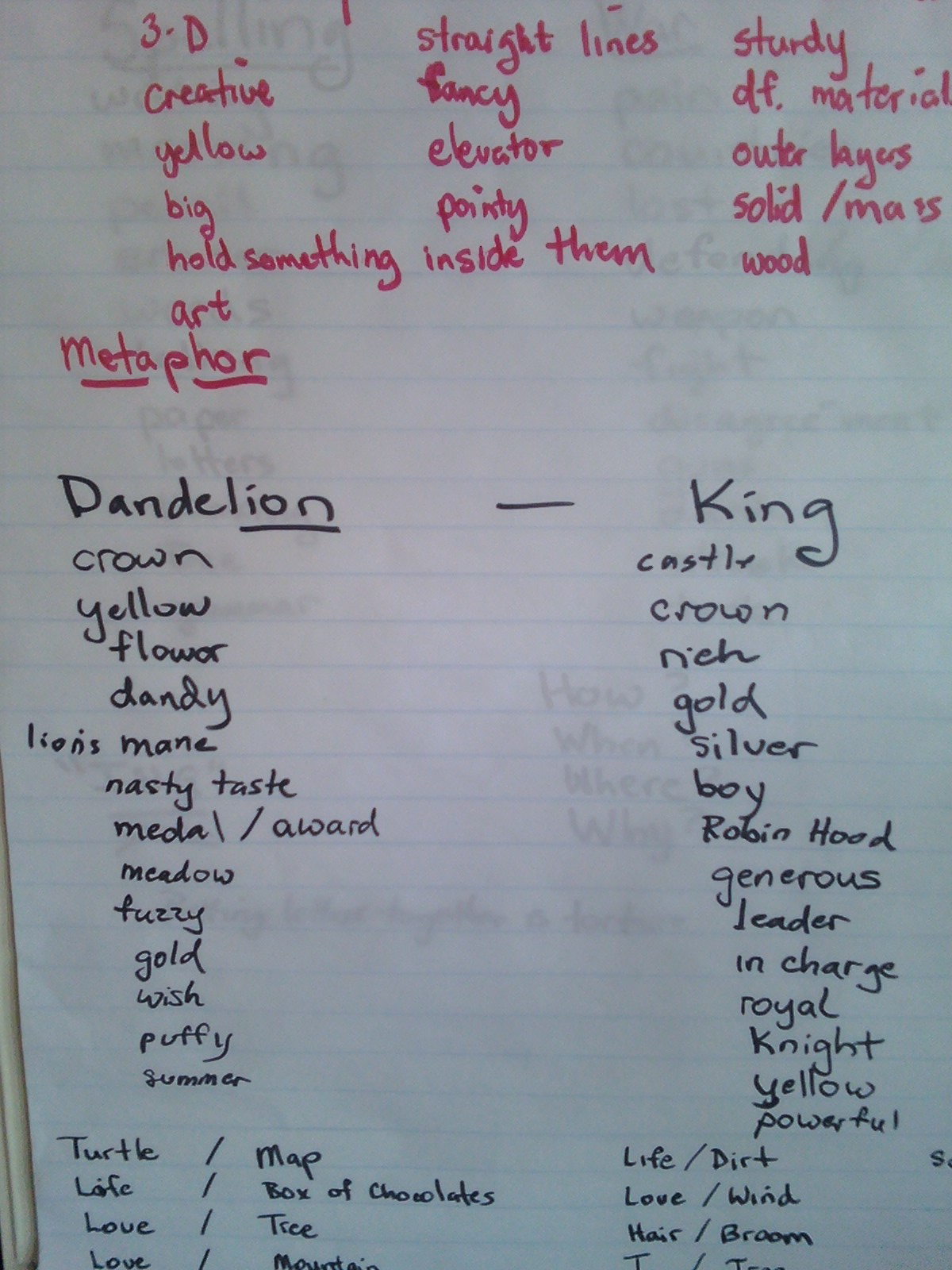
We had the pleasure this week of having, Mr. Frank Hatcher, one of our retired teachers lead our poetry workshop on Friday, November 5th. We explored the concept of metaphor in poetry. Mr. Hatcher shared the poetry of Barbara Esbensen and then we tried writing some metaphors together. He listed two sets or paired words that were seemingly unrelated: pencil/hotel and dandelion/king. We listed words to describe each without looking for relationships between the two. Then, we looked how how we could connect and compare them. We also started to brainstorm two other words : spelling and war. We will continue with that comparison next poetry workshop. See charts below for an idea of what we did. It was so fun to listen to Mr. Hatcher read us poetry and share his expertise. He will visit again!
Saturday, October 30, 2010


Monday, October 25, 2010
Using the Book The Secret Shortcut to learn about story organization
 We recently shared the book The Secret Shortcut by Mark Teague as a model and springboard to learn about story organization (beginning, middle, end), adding details and using transition words to help a story flow. After we shared the story of two boys, Wendell and Floyd and their "secret shortcuts" to school - including a jungle, alligators and quicksand, students created their own story maps and devised new secret shortcuts. These maps included new amazing encounters experienced by Wendell and Floyd on their way to school. After drawing maps, groups created three detailed sentences to go along with each spot on the map. We then talked about how to connect these thoughts with transition words. We will be sharing these in class tomorrow. Next, students will be writing individual stories. They have two choices. Each person can write another version of a shortcut story OR they can choose from a variety of wordless picture books we have in the classroom to create their own story. Look for postings of story maps and group stories soon!
Wednesday, October 20, 2010



The 30 Book Challenge
We posed a challenge to the class this week. The challenge is to read 30 books by the end of the school. year. While this may seem a daunting task, we did talk about the fact that it is supposed to be a challenge. The goal is for each 5th grader is to read 20 books by the end of the year, so this definitely raises the bar. Each person now has a chart glued in to the back of the reading journal to keep track. Book that have already been read this quarter certainly count! As part of the challenge, the books must be in a variety of genres, to push us all as readers out of our comfort zone. The genres include: realistic fiction, historical fiction, fantasy, science fiction, biography, autobiography, traditional (which includes folktales, fairytales, tall tales, legends) poetry anthology, graphic novel, mystery and five your choice books. This idea came from a book we read over the summer: The Book Whisperer: Awakening the Inner Reader in Every Child by Donalyn Miller
Tuesday, October 19, 2010
Book Groups


Beginning today, small groups will begin book groups. With teacher direction, groups will complete readings, discussion and writing about a chapter book. The books we will be reading are shown below. One group will not begin a book group for about two weeks, until the other four groups are finished. This first round of book groups is very teacher directed. After this initial round, book groups will shift to more student led, with the teacher participating as a group member rather than a leader. Book groups accomplish a lot! (see post about why we do read aloud) Beyond read aloud, each individual has the opportunity to read the book independently and then interact with peers through discussion. When the book group is finished, groups will also decide on a way to share with book with classmates.
Monday, October 18, 2010
Farcebook Pages and a Digital Timeline
As a takeoff of a "facebook" page, each person is creating a "farcebook" page to share information learned about a scientist. This particular project gets at the steps of research: collecting articles, forming questions to guide research (as a class, we brainstormed information we thought was important to share with others about the scientists). This information included: scientist birthplace and date, death and any other fact regarding death, family and interesting information about family, intriguing fact about childhood, intriguing fact about scientist's life, major accomplishment(s) to science, how scientist made the world a better place and defining important vocabulary related scientist. Once all of this information is gathered from at least two references, information will be written on a farcebook template page. Pictures and at least one quote will also be included. A second piece to studying the life of a scientist is to create a digital timeline. Each person will choose a photograph that represents the scientist study. Also included will be the date of the scientist's major contribution and a piece of writing. This timeline will be web-based, so can be accessed for all to view once we are finished.
Exploring Science
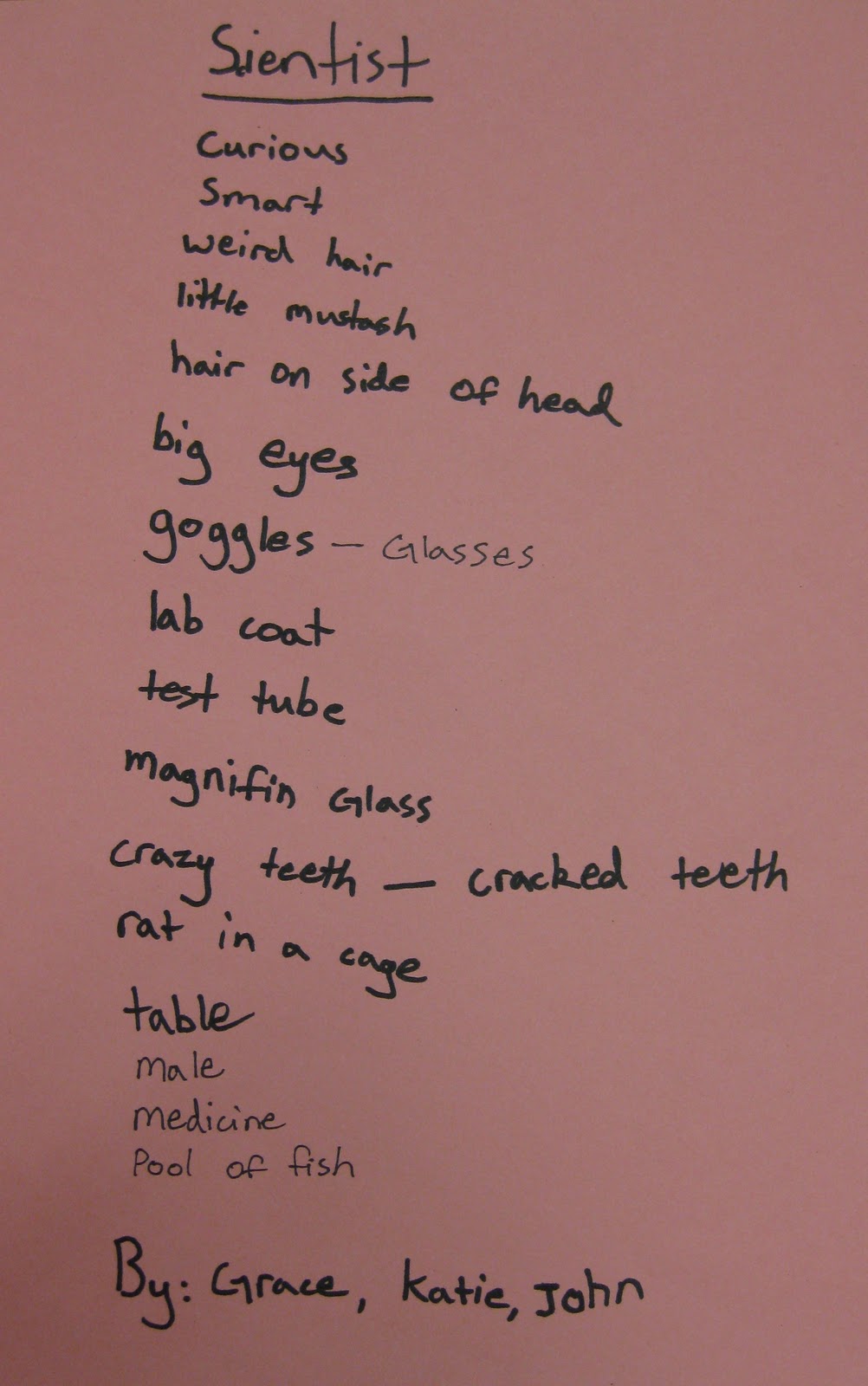
For the last several weeks, we have been exploring what science means. We began with two activities: asking the question, "What is Science?" and Drawing a Scientist. After each person answered the question and drew a scientist, we met in small groups to compile responses. Pictures of those responses will be posted soon. We started with these two activities as a starting point, a way to gather information to show what we think and what we already know. We will revisit these questions after we complete our "Survival by Design" science study (a post about that in the near future), which will carry into the second quarter.
Wednesday, October 13, 2010
Word of the Week Web
We began looking at vocabulary this week by introducing word webs. The word web includes exploring different parts of the word: definition, syllables, part of speech, synonyms, antonyms, using the word in a sentence and creating an illustration. Up until this point, we have been giving words to look up and just discussing the definition.
Saturday, October 9, 2010
Why Do We Do Read Aloud?
One of the 10 Principles of the Informal Program is "We view our school as a center for teaching and learning for all ages." The teachers at Wickliffe are participating in a learning group this year by focusing on a book by Samantha Bennett. She is visiting Upper Arlington to work with teachers this year. The book is titled That Workshop Book. One of things we recently discussed in our class after school was the use of read aloud. We decided to ask the class, Why DO we do read aloud? Below are their responses. They completely understand the reason for read aloud and put it into words better than we ever could have.
Why Do We Do Read Aloud?
•it’s fun
•we learn facts and information about the world
•discover new books, authors or series
•have time to relax
•learn new reading skills and strategies – like predicting, asking questions
•push us as a whole group to be better readers
•helps us learn about new books and books we can recommend to others
•learn new delicious words
•it’s a break from reading on our own
•it’s helps us to read better because we hear someone reading smoothly and with expression
•helps us be better writers because we hear language
•teaches us to make a picture in our head like a movie
•it is a time everyone can come together and listen to a good story
•if you liked the read aloud you can find another book by that author
Why Do We Do Read Aloud?
•it’s fun
•we learn facts and information about the world
•discover new books, authors or series
•have time to relax
•learn new reading skills and strategies – like predicting, asking questions
•push us as a whole group to be better readers
•helps us learn about new books and books we can recommend to others
•learn new delicious words
•it’s a break from reading on our own
•it’s helps us to read better because we hear someone reading smoothly and with expression
•helps us be better writers because we hear language
•teaches us to make a picture in our head like a movie
•it is a time everyone can come together and listen to a good story
•if you liked the read aloud you can find another book by that author
Subscribe to:
Posts (Atom)